May 6, 2011

Flat World, Hard Boundaries – How To Lead Across Them

AS THOMAS FRIEDMAN so persuasively argued in his book The World is Flat,1 a significant effect of globalization is a leveling of the playing field for many of the competitors in today’s worldwide markets. Technological innovations have revolutionized the workplace, bringing the competitive power of emerging economies’ fast-growth organizations into closer alignment with their developed-world counterparts. Paradoxically, at the same time that these developments have made doing business across borders easier, relational barriers — obstacles to productive human interactions — not only remain largely unchanged but in some cases have deepened.

Consider the hurdles faced by those who lead functionally diverse teams across levels of management and with a variety of organizational partners who often are based in different countries. These leaders’ jobs are made easier by the technological advances that help to close gaps involving distance and knowledge. But the leaders also are confronted with entrenched boundaries such as residual bitterness between historical enemies, culture clashes, turf battles and generation gaps. Such boundaries invite conflict, impose limitations on performance and stifle innovation.

THE LEADING QUESTION

What are the major boundaries faced by organizations and what kinds of practices may leaders employ to span them?

FINDINGS
  • The boundaries are vertical, horizontal, stakeholder, demographic and geographic.
  • The practices are buffering, reflecting, connecting, mobilizing, weaving and transforming.
  • Their use results in safety, respect, trust, community, interdependence and reinvention.

It is clear that a flat world requires a shift to new and more effective leadership strategies, especially as leaders move from middle- to senior-level management. But provocative questions must first be addressed: Which boundaries create the greatest challenges? What are the implications for those who manage and execute business strategy when boundaries are constantly changing? How do leaders span these boundaries, thereby potentially enabling groups to achieve results together that are well beyond what they could have done on their own?

Seeking answers to these questions, we and our colleagues at the Center for Creative Leadership developed a comprehensive database from some 2,800 survey responses and nearly 300 in-depth interviews with leaders across six global regions. We also surveyed an additional 128 CEOs, senior vice presidents and directors of some of the world’s most recognizable companies. In this article, we share these findings.2

ABOUT THE RESEARCH >>

The clear message from those who participated in our research is that in a flat world we need “boundary spanning leadership” — the ability to create direction,alignment and commitment across group boundaries in service of a higher vision or goal. Direction is a shared understanding of common goals and strategy, alignment is the joint coordination of resources and activities, andcommitment is a dedication to collective success that is at least as great as the dedication to any one group’s success.3

We have identified five types of boundaries that challenge leaders today and six practices that help them span those boundaries.4 Through these six practices it is possible to transform barriers to progress into new frontiers of opportunity; create, test and execute innovative solutions; and enable organizations to thrive in a flat world.

The Boundaries That Keep Us Apart

Our research revealed that the five most challenging boundaries involve identity and relationships — how we define ourselves and the groups we belong to — and thus are associated with strong emotions such as loyalty, pride, respect and trust.

Vertical boundaries are the floors and ceilings that separate groups according to rank and privilege. Common terms within organizations that convey such boundaries may include span of control, hierarchy chart, top-down/bottom-up and exempt/nonexempt staff. Vertical layers — top-, middle- and entry-level — have become the most common means of defining the existing hierarchy, with a number of lower-level subordinates under a higher-level supervisor being the traditional approach for managing the boundaries between levels. Strategy flows down, with production flowing up. Yet today’s flat world is transforming vertical boundaries, enabling greater degrees of interaction up and down. This shifting landscape is redefining the “control” long associated with span of control.

Horizontal boundaries are found across organizational functions and units, or when two organizations merge into one. They are the walls that separate groups according to areas of experience and expertise. Terms within organizations that convey horizontal boundaries include division of labor, silos, stovepipes, turf battles, front office/back office and revenue center/cost center. As these words may suggest, the negative costs of horizontal boundaries manifest themselves when one function is favored over another, when the work of one unit or product line threatens another’s viability, or when departments work at cross-purposes. Under such conditions, intergroup conflict rather than collaboration rules the day.

Managing the boundaries between functional groups originates in the need for division of labor, but this requirement is being replaced by the need for integration of labor. Integrating functional groups such as marketing and sales to work toward a common goal is challenging enough, but bringing groups together following an organizational merger or acquisition — to transform competitors into collaborators — requires the integration of technical and operational systems as well.

Stakeholder boundaries are the doors and windows of the organization. Organizations are increasingly tied up with a dizzying array of stakeholder groups, including but not limited to shareholders, boards of directors, vendors, networks, customers, advocacy groups, governments and local and global communities. Common terms within organizations that illustrate stakeholder boundaries include iron curtain, closed door, enclave, corporate-centric, not your business and insider/outsider. Stakeholder boundaries have potential to create divides when organizations seek to serve their individual interests at the exclusion or expense of the interests of their external partners.

Value chains are the primary mechanism for managing the boundaries between an organization and its stakeholders. The traditional view is that each link in the chain defines its own process independently, with little thought given to interdependence with partners elsewhere along the chain. But a flat world requires organizations’ leaders to rethink how value is created as it becomes increasingly difficult to locate the edges between participating enterprises in the chain, their employees and the broader communities they serve. For example, consider the experience of India’s Tata Motors Ltd. with its Nano car. Because of its unique modular design, the Nano is sold in kits that are distributed, assembled and serviced by local entrepreneurs and rural garages throughout India. By knitting together a vast network of human capital inside and outside the company, Tata has created an inexpensive product that is now within the reach of millions of Indian consumers.

Demographic boundaries result when workers are defined according to classifiers such as gender, race, education or ideology. Terms that convey such organizational boundaries include glass ceilings, generation gaps, diversity divides, ideological battles and culture clashes.

In recent years, the demographics of the global labor force have been transformed. Consider that of the 45 million jobs created between 2006 and 2007, 57% were located in Asia, 21% in Africa, 10% in Latin America and the Caribbean, and 8% in the Middle East and in central and southeastern Europe (non-European Union). In contrast, only 4% of the jobs created during that period were located in the developed economies.5 These global growth trends will only intensify. Of today’s 1.2 billion youth, nearly 90% live in developing economies, with eight out of 10 hailing from Africa or Asia. This is the global work force of the future. If managed effectively, such trends could result in organizational benefits, as a flat world requires the leveraging of different knowledge bases and diverse backgrounds to achieve value-creating innovation. Poor management, on the other hand, would likely result in great divides.

Geographic boundaries are represented by the physical office location, as well as the phone, e-mail and Internet connections used to bridge time zones and distances. Terms that demarcate geographic boundaries may include East/West, native/foreigner, global/local, headquarters/field and mother ship/satellite. In the past, organizations were the product of, and created products for, their local consumer markets. Today’s markets, as well as organizational operations and labor pools, manifest themselves in all corners of the globe. An American sports apparel company, for instance, might obtain its fabric from China, design and market its clothing in the United States, manufacture the products in Bangladesh, and sell them through a chain of stores with locations worldwide. The virtual dismantling of geographic boundaries creates sourcing and scale efficiencies, as well as new markets and sources for capital. Yet determining what processes to integrate across geographies and what to customize for local needs remains a persistent challenge.

The Boundary Spanning Leadership Model

In our research we identified the six types of practices that enable boundary spanning leadership: buffering, reflecting, connecting, mobilizing, weaving and transforming. Each successive pair of practices constitutes one of three interrelated strategies: managing boundaries (buffering and reflecting), forging common ground (connecting and mobilizing), and discovering new frontiers (weaving and transforming). This “boundary spanning model” is essentially an upward spiral that leaders must travel to achieve intergroup collaboration.

FROM THE GREAT DIVIDE TO THE NEXUS EFFECT

The spiral depicts how boundary spanning leaders increase intergroup collaboration — by first managing boundaries, then forging common ground, and ultimately discovering new frontiers at the nexus between groups.
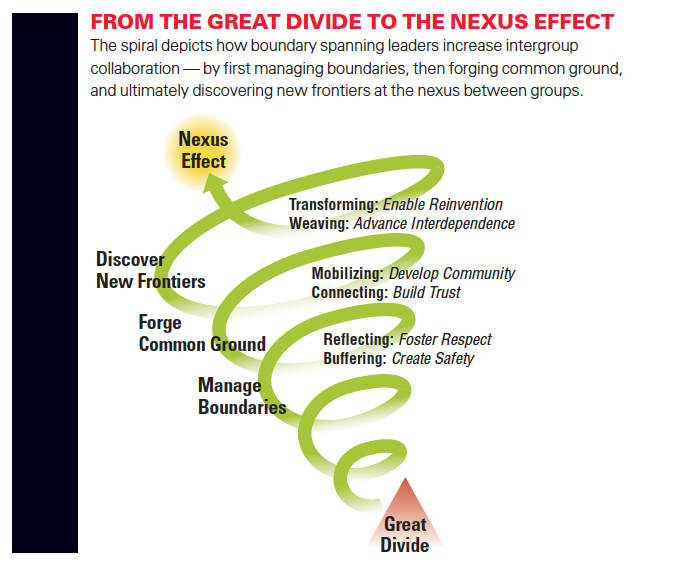
Through execution of the six boundary spanning practices in turn, leaders can enable what we call a “Nexus Effect” — groups working together to create new possibilities and achieve inspired results well beyond what they could do on their own. The Nexus Effect is the ultimate goal of boundary spanning leadership, and it is the countervailing process to what we call the “Great Divide.”

The emotional force that serves both to separate and connect us — identity — is at the heart of the Great Divide. Identity results from the interplay between two basic human needs: the need for differentiation or uniqueness and the need for integration or belonging.6 We believe that the reason the five boundaries cited above are so difficult to manage is not just that they represent physical or technological differences that separate groups. More importantly, they represent differences in how we define ourselves. Identity is not about what we do or how we do it but rather who we are.

While the Nexus Effect is the most positive outcome that can occur when group boundaries intersect, the Great Divide is considered the most negative. Shown appropriately in “From the Great Divide to the Nexus Effect,” the alienating situation results without the intervention of the six boundary spanning practices. When intergroup boundaries collide and groups feel threatened by their differences, a divide splinters groups into us versus them. The creation of shared direction, alignment and commitment moves further and further out of reach, with constrained and counterproductive results.

The Six Boundary Spanning Practices

By contrast, boundary spanning practices have decidedly positive effects, as they enable leaders to progress up the spiral from managing boundaries to forging common ground to discovering new frontiers at the nexus between groups. Boundary spanning leaders see boundaries not just as problems to solve but as potential opportunities, and they pursue this quest through the six practices, which are discussed in turn below.

Buffering Group members cannot collaborate effectively across boundaries unless they first feel protected within their own group. Thus the practice of buffering involves shielding group members from threats or undue outside influences so that they can develop and maintain a clear group identity. The result is that buffering builds intergroup safety — the state of psychological security that arises when boundaries allow each group to define its reason for being.

A boundary spanning leader then helps groups work across, around and through boundaries to engage in productive work with other groups, whether inside or outside the organization. At the same time, the leader must continue to serve in part as a buffer — to keep group boundaries strong enough to protect groups and keep them whole. If boundaries become too weak or disappear altogether, a group’s purpose will weaken or disappear as well.

For example, Lisa, a manager at a telecommunications company, was struggling to lead a cross-functional team tasked with rolling out a new smartphone product line. The team had not been making progress because its members were subject to too many external and often-competing demands. Finally, Lisa decided to pull the team together, clarify its mission and determine each member’s area of responsibility. Each person came to know what he or she should and should not be doing. By thus buffering the team and strengthening its boundaries, Lisa facilitated the accomplishment of the team’s mission.

Reflecting As its name implies, this practice enables a group to see both sides of a boundary and allows other groups to do likewise. Much as a mirror’s image is available for all to see, the practice of reflecting involves informing one group about another. By illuminating the differences and similarities between groups and helping each one understand the identities of the other groups — through attending some of their meetings, say, or reading postings on their Intranet site — reflecting involves sensitizing group members to their counterparts’ values, priorities, expertise, roles and needs. With this practice in place, groups can begin to see common ground in goals and objectives, and the way is cleared for intergroup respect and collaboration.

For example, DriveTime, a Phoenix, Arizona, company that owns used-car dealerships, had its employees partner with elementary schools that serve at-risk students. The goal was for the company to better understand its low-income customers, better serve the community, and in turn be better understood by the community. As a result, employees developed greater empathy and awareness of their customers in ways that stood in stark contrast to the common perceptions of the used-car industry as one that preys on a vulnerable population.

Connecting This practice, which seeks to forge relationships by creating person-to-person linkages, occurs when group members temporarily put aside their group identities and step inside a neutral zone where people can interact with one another as individuals. If such connecting is sustained over time and new relationships are built, the boundaries that created rigid borders between groups become more porous and intergroup trust may grow. With this practice in place, groups may create a shared direction, develop common expectations (regarding the coordination of tasks, for example), and maintain the mutual confidence that each group is committed to shared overall interests.

PRACTICES VS. BOUNDARIES

Each cell of this matrix is a sample action that a leader may take in employing one of the six practices to span one of the five types of boundaries.

One tactic for achieving connectivity is to create “attractor spaces,” which suspend at a particular time or place the physical boundaries that separate an organization’s groups, functions, levels or divisions from one another. Such boundaries were of course intended to improve productivity by enabling people who share responsibilities to work in close proximity, but the cost is that they impede any one group from collaborating with others. To help balance the resulting tensions, leaders need to create attractor spaces that encourage serendipitous cross-boundary relationships to develop.

Take “the Googleplex” — Google’s headquarters in Mountain View, California. Everything from the entry-level “town square” to the “village library” beckons employees to leave their desks and mingle. Throughout the building, floors are organized into flexible neighborhoods and shared community spaces that similarly make it easy for people to meet. For example, employees eat for free in an open cafeteria, which also boasts a giant white board to capture ideas that may emerge from casual lunchtime conversations.

Mobilizing This practice seeks to reframe boundaries and craft common purpose. It encourages groups to transcend their smaller group identity and create a new and larger identity that is shared by all. Mobilizing enables groups to look beyond the differences that divide them into factions and to instead form coalitions for working together productively. The result is intergroup community — a state of mutual belonging and ownership that develops when boundaries are reconfigured and collective action taken. When this practice is in place, groups may realize a galvanizing higher purpose — share an inclusive identity, coordinate resources and take collective action — even when outside forces try to pull them apart.

Mobilizing is similar to connecting in that both practices enable the forging of common ground. A distinction, however, is that whereas connecting is about suspending the dividing lines between individual group members, mobilizing redraws the lines to include both groups.

One mobilizing tactic is to narrate stories, which throughout human history have served as a powerful force for expressing common identity. Boundary spanning leaders can likewise draw upon stories to create meaning and transcendent purpose. When the Chinese computer company Lenovo purchased IBM’s global personal computer operation in 2005, senior leaders moved quickly to craft a narrative of Lenovo as a “New World company” that synthesizes the best of East and West. This narrative transmits values to guide and instruct behavior. In particular it encourages disparate groups to work together as members of a shared community.

Weaving This practice occurs when group boundaries interlace yet remain distinct, much like an accomplished weaver bringing together different threads to create larger patterns. In an organization, each group has a unique role or contribution that is integrated in the pursuit, say, of the next big product or service.

While weaving meets the need for differentiation by respecting varied experience and expertise, it also meets the need for integration by forming new collaborations across groups that utilize their differences to achieve a common purpose. The result is intergroup interdependence — a state of mutual reliance and collective learning. When this practice is in place, the groups involved not only enhance their own effectiveness but also can co-create a single overall direction, work together to realign collective resources as business requirements change, and exploit diverse perspectives to enhance the effectiveness of the larger organization.

Leaders at Child Rights and You, an organization that advocates for underprivileged children, used a weaving tactic to realize a significant change in strategy. Spanning 17 Indian states, CRY reflects vast regional differences — in language, ethnicity, religion and caste — among its members. To take advantage of their varied perspectives and experiences to better serve the organizational mission, a team led by CEO Ingrid Srinath asked people throughout CRY to “bring their differences into the room.” Multiple cross-boundary dialogues were held where people representing diverse regions, as well as functional groups, participated in deep and open conversations about the future direction of the organization. Differences were aired and frankly discussed. Rather than being seen as problems, these differences were embraced, ultimately enabling CRY to consider a broader range of options.

Transforming The sixth and final practice is about intergroup reinvention — the state of renewal that develops when groups create new identities, and new possibilities, by reworking the boundaries between them. Essentially, transforming occurs when time and space are provided for group members to open themselves to change.

When multiple groups are brought together in search of reinvention, each of the approaches described for the previous five practices can also be used. Thus, transforming can be thought of as a gestalt — as the integrated totality of the six boundary spanning practices. When transforming is successful, problems that were previously intractable may be resolved, and options that were considered far beyond reach may become not just viable but fully realizable.

Butch Peterman, the president of Abrasive Technology Inc., a globally integrated manufacturer of precision grinding and tooling products based in Lewis Center, Ohio, decided that his company should transform itself from a functionally organized manufacturer with strict division of labor to an innovative, customer-focused and process-centered organization — a goal that required people at ATI to change how they define themselves and their company. Responding with vigor, they tossed out the use of traditional managerial roles and created nontitled roles around core tasks. All employees were assigned a process and thought of as associates fully responsible for managing the work, as well as for continuing to develop themselves and others. Today, the company is team-oriented, coaches have replaced supervisors, and horizontal cross-training and role flexibility is the norm. The organizational benefits? Among others, ATI has reduced product returns, improved the performance of lower-performing plants, and decreased staff turnover rates to near zero.

Other examples of actions that leaders can take — for each practice applied against each boundary — are given in the matrix “Practices vs. Boundaries.”

The Leadership Advantage


The six boundary spanning practices result in safety, respect, trust, community, interdependence and reinvention — outcomes needed to create a Nexus Effect, when groups achieve inspiring results together that far exceed what they could have achieved on their own. When an organization becomes a place of mutual trust, interdependence and collective action, new avenues for creativity and innovation can come into view. Breakthroughs and inspiring applications may occur, and alternative futures could be realized. And if enough boundary spanning leaders were to emerge in enough organizations, entire economies could be energized.

There is little doubt that organizations wish to marshal creativity and innovation as a critical part of their organizational strategy in these challenging times. Among a list of societal trends, 92% of senior executives in our research described the drive for innovation as the trend having the most important impact on their organizational strategy for the next five years. But innovation is largely dependent on effective boundary spanning, not only internally — across levels, functions and locations — but also between the organization and its stakeholders. In an ever-flattening world, boundary spanning leaders have the advantage, being well positioned to achieve transformative results for their organizations and the broader communities being served.

(Reprint #:52306)

Chris Ernst is a senior enterprise faculty member at the Center for Creative Leadership in Greensboro, North Carolina. Donna Chrobot-Mason is an associate professor in the Department of Psychology at the University of Cincinnati.

Interview with K. Lynch

Why did you develop your trilogy, originally published in three books, to be put into one book?
The reason I combined the three books into a trilogy was to allow a meaningful introduction about the history of the founding of Berneau. This was where all the events culminated in the ending. I just thought it would make things sort of interesting to begin with the history from the late 18th century and bring it into modern times – similar to what James Michner does, but in a smaller sense.
It provokes thoughts of romance, mystique, greed and malice. The story begins in the middle of the French revolution and continues through current times. The events emulate the most noteworthy of the seven deadly sins as well as the consequences thereof.

How does it feel to be writing romance as a man?
Writing about romance from a male point of view is very challenging. I find that women, by their nature, are much more thoughtful and considerate in describing their characters. I sort of wanted to do that, but may have been a little bit more realistic since the affairs dealt with true events.

Why did you decide to write a romance novel?
I actually initially began this venture for my own enjoyment. The reviews for the first part, THE MILLION DOLLAR THERAPIST, were encouraging; however, and many of the reviewers wanted to know what happened to the main characters. As a result, I added two more parts.
How much of your personality and life experiences are in your writing?
In the second part, THE OTHER SIDE OF THE HORIZON, I write based largely on personal experience. The medical occurrences are derived largely from personal knowledge withunderstandable changes in names and places.
What kind of research did you do?
I did extensive research into almost every facet of the book. This includes details of the French revolution, banking practices in the 1800’s, Spanish trade routes, and indigenous Caribbean tribes. For parts of the book taking place in more modern times I researched out life on a rural farm, personal aircraft (including the pilot’s manual for Learjets), the most exotic golf club brands, current politics, and ancient boats as used in modern times. The medical portions included were drawn on my own knowledge of medicine acquired from the last 40 years in practice. I also drew largely from my military experience as an airborn flight surgeon in the early ‘70’s.
Would you like to write a different genre than you do now, or subgenre?
Not really; I recently published a book on Kachinas, but it was just describing my own personal collection.
Please tell us about yourself (hobbies, pro background, etc.)
I am a medical doctor, now specializing in Diagnostic and Interventional Radiology. I attended both Johns Hopkins and USC School of Medicine in the 1960’s. My hobbies include shipbuilding, collecting nautical antiques, antique rifles and antique medical equipment. I also collect Hopi Kachina Dolls. I have read extensively on surgical techniques of the 1700’s and 1800’s. I have also read extensively on art of the indigenous American Indians, especially that of the Hopi tribe.
Who, if anyone, has influences your writing?
I really admire Nicholas Sparks – I just want him to write a book with ahappy ending and stop being so realistic.
Among your own book, have you a favorite hero or heroine?
All my female characters are my heroines –Carol Lindsay, Dianne Merrill, Sophia Bergeron, and Mme. du Boulier. Their personalities are derived from personal prior relationships. I was so enamoured with Mme. du Boulier that I “re-incarnated” her as Mariana in the final part of my book.
Which comes first, the story, the characters, or the setting?
In this particular case I believe one of the main characters, Carol Lindsay, came first.
What are the elements of great romance for you?
To me the elements include true love, sensuality, humor and extreme intimacy. I strive to describe these situations without being graphic.
What is the most rewarding thing about being a writer?
I love being in full control of the outcomes. Paradoxically, I think some of my characters got a little out of hand.
Biography:

K. Lynch is a Southern California native. When not crafting his next work of fiction, the author is a medical doctor with more than thirty years in private practice. He has come to devote his spare time to his original love – writing.

He has trained at Johns Hopkins and USC School of Medicine and has since been engaged in the practice of medicine. He currently works as an interventional radiologist. He was also active as an ER doctor in the mid-seventies and was an airborn flight surgeon during the Vietnam Conflict.

Lynch began writing romance novels about four years ago. Much of what occurs in his book, Beyond Ecstasy: A Trilogy, are based on actual true events with time and names altered. All details have been researched in full – with the exception of the mythical tribe of the Pitacaci and the Island of Berneau, as depicted in Lynch’s story.
Books: BEYOND ECSTASY

May 4, 2011

વિશ્વમાં હિંદુ સંપ્રદાય નું મહત્વ શા માટે છે ?

તેનું પુસ્તકનું ગુજરાતીમાં સંકલન કરું છું જે ટૂંક સમયમાંજ આપની સમક્ષ આવી જશે.

May 3, 2011

Army and prisons officials to lead new programme Read more: Army and prisons officials to lead new programme http://www.nst.com.my/nst/articles/04bos

The National Blue Ocean Strategy (NBOS) programme launched yesterday involves two lead agencies -- the army and the Prisons Department.

Army chief Gen Datuk Seri Zulkifeli Mohd Zin and Prisons Department chief, Commissioner General Datuk Zulkifli Omar, told a media briefing recently that the programme was an effort between several ministries and government agencies.

They include the Ministries of Defence; Home; Agriculture and Agro-based Industry; Information, Communications and Culture; Rural and Regional Development; Health; and the Civil Defence Department.


The NBOS programme is divided into three segments:

NBOS 1 -- The redeployment of policemen to reduce crime;

NBOS 2 -- The community rehabilitation programme for prison inmates (with less than two years' jail sentence) at army camps; and,


NBOS 3 -- Household assistance, rural water supply and optimal use of vacant armed forces land for agriculture.

Under NBOS 1, 7,402 police officers below the rank of assistant superintendent and other policemen will be mobilised from desk duties to high-risk areas, aimed at reducing crime under the National Key Results Area initiative.

Their roles in the office will be filled by 4,000 staff from the Administrative and Diplomatic Service and civillians.


Under NBOS 2, the armed forces and police will collaborate in training constables, undertake joint patrols, facilitate ex-servicemen from the Army to serve with the police and oversee operations like Ops Wawasan (anti-crime operation at the Malaysia-Thailand border) and Ops Nyah (operation against illegal immigrants).

The community rehabilitation programme for prison inmates will start at five army camps for 1,200 inmates.

A total of 240 Prisons Department staff and 300 soldiers will supervise inmates who will work as grass-cutters, drain cleaners, landscapers and painters.

Additionally, inmates at the Syed Sirajuddin Camp will be roped in for fish-breeding and agriculture projects.

"These activities are to equip the inmates with skills to provide an avenue for them to be independent after their release from prison.

"This will ensure that they do not resort to crime again to survive," Zulkifeli and Zulkifli said.

The initiative was also expected to save money for the government in its efforts to ease congestion at prisons.

The government could save RM281 million in building new rehabilitation centres at the five Army camps, instead of new prisons.

"We can save RM8.8 million for the maintenance work done by inmates and generate RM2.13 million in revenue from the fish-breeding and agriculture activities," they said.

For the training of constables at army camps, 2,000 had begun training at the army's Basic Training Centre (Pusasda) in Port Dickson, and another 500 at the Naval Recruit Training Centre in Tanjung Pengelih, Johor, since Jan 18 this year.

The training is for six months.

"This will save the government RM600 million to train 10,000 constables over four years."

Joint patrols by the army and police, and manning of roadblocks and escorts in Seremban, Port Dickson, Taiping and Ipoh had begun since early this year.

A total of 101 ex-servicemen, including five women, began their three-month induction training to join the police since Jan 18 and will be appointed as senior corporals.

The household assistance programme, under the NKRA rural infrastructure initiative, will see the renovation and construction of 485 homes of the poor from February till year-end.

The NBOS 3 programme, they said, would synergise all the relevant government agencies.

"Additionally, it will provide staff of the agencies 'on-the-job-training' and reduce infrastructure costs ."

'Blue ocean' ways to solve 5 issues

A National Blue Ocean Strategy (NBOS) programme to reduce crime, rehabilitate prison inmates at army camps, provide household assistance, ensure rural water supply and optimise vacant armed forces land for agriculture took off yesterday.

The use of the strategy had proven effective in several of the government's innovative programmes.

Prime Minister Datuk Seri Najib Razak said the government had found the formula contained in the theoretical business strategy particularly beneficial in maximising output, while incurring the lowest cost possible.


"The Blue Ocean Strategy is a management tool which can be applied in the government's administrative context as it enables us to think out of the box with good results.

"It will be expanded to other initiatives," he said while launching the Communitisation Rehabilitation Programme at the army's Mahkota Camp here yesterday.

The Blue Ocean Strategy is a business strategy book first published in 2005, and written by W. Chan Kim and Renee Mauborgne.


It illustrates the high growth and profits an organisation can generate by creating new demand in an uncontested market compared with competing with other suppliers for known customers in an existing industry.

The rehabilitation of petty criminals programme, which was adapted from the Blue Ocean Strategy, placed prisoners at low-security detention centres within army camps.

Najib said the new concept was better than placing them with hardened criminals in normal prisons, as it was proven that such corrective methods would only increase the number of criminals in society.


"Under this detention concept, the petty criminals will not be influenced to become worse by those who had committed serious crimes.

"This increases their chances of returning to society. The facilities at the detention centres also allow weekly visits by family members and, hopefully, this will make them feel remorseful for the things they did."

Inmates at such detention centres are also allowed to earn a small wage by doing odd jobs around the army camp.

"The government will also save a lot of money this way as we do not need to build more prisons," said Najib, adding that such a detention centre costs only RM4.5 million, while a conventional prison costs between RM50 million and RM60 million.

There are 200 inmates at the detention centre in Mahkota Camp.

Other army camps, which would be among the first to host detention centres, are Syed Sirajuddin Camp in Gemas, Tok Jalai Camp in Alor Star, Batu 10 Fourth Mechanised Briged Camp in Kuantan and Desa Pahlawan Camp in Kok Lanas.

Najib said such an innovative approach could also be seen as cooperation between the armed forces and police in training their officers.

"We will try to utilise the same application from the Blue Ocean Strategy to our efforts, particularly those under the National Key Results Areas," he added.


આજે ગુજરાત એક સ્વર્ણિમ જયંતી મહોત્સવ ઉજવે છે ત્યારે એક બાજુએ આપને ક્યારેક વિચારીએ છીએ કે ગુજરાત ની જનતા એ શું આ મહોત્સવમાં ભાગ લેવો જોઈએ કે નહિ?
જવાબ છે "ના".

૨૭૦ કરોડ રૂપિયા ના ધુમાડા પછી જો માત્ર ગુજરાત ની જનતાને ખુશ કરવા માટે જ પ્રોગ્રામ કરવા હોય તું તેને અનાજ આપો. રહેવા માટે મકાન આપો. મોંધવારી દુર કરો. બેકારો ને નોકરી આપો. ત્યારે જ ગુજરાત નો દરકે માણસ પોતાને અને સરકાર ને ભાગ્યશાળી સમજશે. હું ગુજરાત સરકારના પ્રોગ્રામની વિરુદ્ધમાં નથી પરંતુ આજે ગુજરાતમાં ૬ કરોડ ની વસ્તી માંથી ૫૫ લાખ લોકો ભિખારી છે કે જેઓને દિવસમાં ખાવા માટે અનાજ નથી મળતું કે રહેવા માટે મકાન નથી. શા માટે આજે નાની ઉમરના છોકરાઓ આત્મહત્યા કરે છે?

તેને રોકવા માટેના કઈ ઉપાય સરકાર પાસે છે ખરા?

ગુજરાત ના મુખ્યમંત્રીની જવાબદારી શું છે ? દરેક નાગરિકનું કેમ રક્ષણ કરવું? માત્ર પ્રોગ્રામ આયોજિત કરવાથી આ બધું નથી થતું.

માણસ અંદર ને અંદર પીડાય છે. કોઈ બોલતું નથી કેમ ? ભય છે કે મારું જીવન સલામત નથી.

કોણ કરશે આનો ઉપાય? કોણ લાવશે ક્રાંતિ ? હવે તો સરદાર વલ્લભભાઈ પટેલ બનવું જ રહ્યું.

May 2, 2011

"લાદેનની કતલ કરી" એવા સમાચાર પ્રસિદ્ધ કરીને અમેરિકાએ આજે વિશ્વ ને અચંબા માં નાખી દીધું છે.

થોડા સમય પહેલા લાદેન જીવતો છે તેવા સમાચાર આપીને અમેરિકાએ બધાને ચેતવ્યા હતા અને હવે !!!

લાદેન બહુ જ હોશિયાર માણસ છે. તેને તેના જેવા ૧૦૦ માણસો ની આબેહુબ નકલ બનાવી છે.

જોઈએ હવે અમેરિકા શું કરે છે ?
આજે દરેક કંપનીમાં પ્રવેશ લેતા પહેલા એ જાણવું ખુબ જ જરૂરી છે કે પોતાની લાયકાત પ્રમાણે નું કામ કંપની આપે છે કે નહિ. મારા એક મિત્ર હમણાજ એક બહુજ પ્રખ્યાત કંપનીમાં જોબ મળવાથી ખુબ જ ખુશ હતો. નવા સપના અને ઉમંગ લઇ ને તે પોતાના પ્રથમ દિવસે હાજર થયો.

થોડા દિવસો ગયા પછી તેને ખબર પડી કે અહિયાં તો મારા લાયક કશું કામ જ નથી. જયારે એને તેના ઉપરી અધિકારી ને જાણ કરી તો તેને ખબર પડી કે માત્ર કંપનીએ તેની ભરતીની પ્રક્રિયા પૂરી કરવા માટે જ તેની નિમણુક કરેલી. તેને ભયંકર આધાત લાગ્યો અને તેને છેવટે રાજીનામું આપી દીધું.

આ માત્ર એક કે બે કંપનીમાં નથી થતું. દરેક કંપનીની આ લાચારી છે.

"હાથી ના દાંત દેખાડવાના જુદા ને ચાવવાના જુદા."

તેમાં મુખ્ય ફાળો એ કંપનીએ કરેલું પ્લાન્નીંગ અને તેની વ્યૂહ રચના ખુબ જ મહત્વનો ભાગ ભજવે છે.

આજે જાણી ને ખુબજ આનંદ થયો કે કે વી કામથ કે જેઓ આઈ સી આઈ સી આઈ બેંક ના વડા છે તેઓ એ ઇન્ફોસિસ જેવી કંપનીના ચેરમેન સ્વરૂપે આવી ગયા છે. તેમના મત પ્રમાણે એ પોતે ઇન્ફોસિસ ની કમાન સાંભળી શકશે પરંતુ નારાયણ મૂર્તિ નહિ બની શકે. ખુબ જ મહેનત પછી નારાયણ મૂર્તિની ઉતારોધીકારીની ખોજ કરવામાં ઇન્ફોસિસ સફળ થયું છેં.

ખુબ જ સાદાઈ પૂર્વક જીવન જીવનાર નારાયણ મૂર્તિ આજે કોર્પોરેટની દુનિયામાં શક્તિશાળી માણસ ગણાય છે. ટીપે ટીપે સરોવર ભરાય, એવી મનોવૃત્તિ રાખનાર નારાયણમૂર્તિ આગામી દિવસો માં નિવૃત થાય છે. એવું કહેવાય છે કે ગાંધીજી તો માત્ર ગાંધીજી જ બની શકે. બીજા નહિ. તેજ પ્રમાણે નારાયણમૂર્તિ એ માત્ર ઇન્ફોસિસ ને ધબકતું રાખવા માટે પોતે જાતે પ્રયત્નો કરવા પડશે જ.
આજકાલ કંપનીઓના ઉતરોઅધિકlરિનિ ચર્ચા ખુબ જ પુર જોશમાં ચાલુ છે. દરેક કંપની ને પોતાની પ્રોડ્કત ટકાવી રાખવા માટે અલગ અલગ વ્યૂહરચના અપનાવવી પડે છે. આ વ્યૂહરચના તેમના ટોચના અધિકારીઓ દ્વારા રચવામાં આવે છે. પરંતુ જો તે વ્યૂહરચના ઘડનાર માનસ નિવૃત થઇ જાય અથવા કંપની બદલે તો તમામ જવાબદારી તેનાથી નીચલા વર્ગના કર્મચારી માથે આવી જાય છે અને શરુ થાય છે કંપની માં એક બદલાવનું વાતાવરણ.

થોડા સમય પહેલા વાંચેલું કે રતન તાતા નું અનુગામી કોઈ મળતું નથી. ખુબજ આશ્ચર્ય થયું કે આવડી મોટી તાતા જેવી કંપનીને ચલાવવા માટે કોઈ વ્યવસ્થિત માણસ મળતો નથી. આનાથી એક વાતની ખાતરી થઇ કે કોર્પોરેટ બજાર માં યોગ્ય વ્યક્તિની અછત છે. પરંતુ શા માટે આવું થાય છે? કર્મચારીને સાચવતા નથી આવડતા કે પછી તેને યોગ્ય પગાર નથી મળતો?

આવા કેટલાય પ્રશ્નો છે કે જેનો ઉકેલ આવતા વર્ષો વીતી જાય છે.

April 29, 2011

Am I Multitasking

Am I Multitasking so much that it's significantly slowing my completion of tasks ?

Ask yourself this question at least twice in a day..

April 26, 2011

The 10 Greatest CEOs of All Time

It's a familiar scene. An industry under fire. A congressional committee demanding answers. A corporate CEO called to testify.

Yet the familiarities, in this case, end there. When Boeing CEO Bill Allen appeared before a House subcommittee—addressing charges that military aircraft makers had improperly inflated profits at the government's expense—there was no lawyer whispering in his ear. There were no notes before him. There was no hint that he wasn't personally responsible for Boeing's actions. And when he had finished his quietly forthright explanation, there was no question that Boeing—far from gouging the government to pad executives' bonuses—had in fact been laying the foundations for future greatness, plowing profits into research and development. The committee's response now seems unimaginable: It erupted into a standing ovation.

That image, from 1956, kept popping to mind whenever someone asked me about the business meltdowns of 2001 and 2002. What, went the questions, should be done about governance? What should Congress do? What should boards do? What, what, what?

I usually declined to comment, feeling I had little to say that had not already been said. But as the Allen image lingered, I came to realize that I did have something to say. It's just that my answer wasn't a what answer. It was who.

When the debates over governance mechanisms and procedural reform are all said and done, one question will still tower above all others: Who should we choose to run our corporations? In the 1990s, it's now clear, boards increasingly gave the car keys to the wrong people. Like doctors bleeding patients to death in the 1600s, the boards weren't trying to do harm. They were simply using the wrong models.

Yet where, these days, are the right models? For good reason, we've become cynical about CEOs. There seem to be no heroes left standing, no one to emulate or believe in. There's an increasingly gloomy sense that we should simply throw up our hands and give up on corporate leadership.

I disagree. Having spent years studying what separates great companies from mediocre ones, I can say unequivocally: There are role models to learn from—albeit not the ones you might expect. It's what inspired me to go back to my research and assemble my list of the ten greatest CEOs of all time.

Who made the cut? Some names on the list will be familiar, while several you might expect to see—names like Gates, Grove, Welch, and Gerstner—weren't eligible for a simple reason: Great CEOs build organizations that thrive long after they're gone, making it impossible to judge their performance until they've been out of office at least ten years. That criterion—legacy—was one of four I used to winnow a universe of more than 400 CEOs. I also scored the top candidates on impact (presiding over innovations—whether technical or managerial—that changed things outside the company's walls), resilience (leading the company through a major transformation or crisis), and financial performance, measured by cumulative stock returns relative to the market (or other financial metrics in the case of pre-IPO companies) during the CEO's tenure.

So what, exactly, made these ten so great? Strikingly, many of them never thought of themselves as CEO material. The second-greatest CEO on the list initially refused the job on the grounds that he wasn't qualified. No. 9 described herself as "scared stiff." No. 5 was once told flatly, "You will never be a leader." Striking, too, is the sheer scale of their time frames. Surrounded by pressures to manage for the quarter, they managed for the quarter-century—or even three-quarters of a century. The No. 4 CEO shaped a company that would average 15% earnings growth for an astonishing 75 years.

Yet if one thing defines these ten giants, it was their deep sense of connectedness to the organizations they ran. Unlike CEOs who see themselves principally as members of an executive elite—an increasingly mobile club whose members measure their pay and privileges against other CEOs'—this group's ethos was a true corporate ethos, in the original, nonbusiness sense of the word corporate: "united or combined into one." They understood the central paradox of exceptional corporate leadership: On the one hand, a company depends more on the CEO than on any other individual. Only the CEO can make the really big decisions. Yet a company equally depends on the CEO's understanding that his or her role still represents less than 10% of the total puzzle. Much depended on them, but it was never about them.

Inclusion on this list would surprise, if not horrify, more than a few of them. But if the question is how to identify more of the right leaders—and how a new generation can learn to become the right leaders—there is no better answer than these ten. In an age of diminished standards, those they set loom larger than ever.

No. 10: David Packard
Rejected the CEO club

His eulogy pamphlet identified the Hewlett-Packard co-founder as 'Rancher, etc.'

In 1949, 37-year-old David Packard attended a meeting of business leaders. Fidgeting while they discussed how to squeeze more profit from their companies, he was finally unable to contain himself. "A company has a greater responsibility than making money for its stockholders," he asserted. Eyes turned toward his six-foot-five-inch frame. "We have a responsibility to our employees to recognize their dignity as human beings," Packard said, extolling his belief that those who help create wealth have a moral right to share in that wealth.

To his elders, Packard's ideas seemed borderline socialist if not outright dangerous. "I was surprised and shocked that not a single person at that meeting agreed with me," Packard reflected later. "It was quite evident they firmly believed I was not one of them, and obviously not qualified to run an important enterprise."

That was just fine with David Packard. He never wanted to be part of the CEO club; he belonged to the Hewlett-Packard club. In an era when bosses dwelt in mahogany-paneled sanctums, Packard took an open-door workspace among his engineers. He practiced what would become famous as "management by walking around." Most radical of all for the time, he shared equity and profits with all employees.

What set Packard apart, in other words, is that he wasn't a person set apart. His idea of a good time, according to a co-worker, was to get together with friends and string barbed wire. Despite being one of Silicon Valley's first self-made billionaires, he continued to live in the small, understated house he and his wife had built in 1957. And though he donated (with Hewlett) to Stanford University an amount comparable to the present value of Jane and Leland Stanford's original endowment, he never allowed his name to appear on any of its buildings while he was alive. By defining himself as an HP man first and a CEO second, Packard did more than demonstrate humility. He built a uniquely dedicated culture that became a fierce competitive weapon, delivering 40 consecutive years of profitable growth.

While Packard's values have since waned within HP, he did more to create the DNA of Silicon Valley than perhaps any other CEO. Like the heritage left by the architects of democracy in ancient Athens, the spirit of his and Hewlett's system lives on, far beyond the walls of the institution they built.

No. 9: Katharine Graham
Wasn't afraid of fear

The Nixon White House threatened her, but the chief of the Washington Post Co. didn't flinch.

On Aug. 3, 1963, Katharine Graham heard the crack of a gunshot within her house. She ran downstairs to discover that her husband, Philip, lay dead by his own hand.

On top of the shock and grief, Graham faced another burden. Her father had put the Washington Post Co. in her husband's hands with the idea that he'd pass it along to their children. What would become of it now? Graham laid the issue to rest immediately: The company would not be sold, she informed the board. She would assume stewardship.

"Steward," however, would not describe Graham's approach to her new role. At the time, the Washington Post was an undistinguished regional paper; Graham aimed for people to speak of it in the same breath as the New York Times. A crucial decision point came in 1971 when she confronted what to do with the Pentagon Papers—a leaked Defense Department study that revealed government deceptions about the Vietnam war. The Times had already incurred a court injunction for publishing excerpts. If the Post published, it risked prosecution under the Espionage Act. That, in turn, could jeopardize the company's pending public stock offering and lucrative television licenses. "I would be risking the whole company on this decision," Graham wrote in her memoir, Personal History. Yet to opt for assured survival at the cost of the company's soul, she concluded, would be worse than not surviving. The Post published.

Eventually vindicated by the Supreme Court, it was a remarkable decision for an accidental CEO who suffered from lifelong feelings of insecurity; phrases like "I was terrified" and "I was quaking in my boots" pepper her memoir. That anxiety would soon reach a crescendo as Post reporters Bob Woodward and Carl Bernstein doggedly investigated what became known as Watergate. Today we take that story's outcome for granted. But at the time, the Post was largely alone in pursuing it. In choosing to publish, Graham built a great paper and, in turn, a great company—one that ranks among the 50 best-performing IPOs of the past quarter-century and earned the investment of Warren Buffett. Graham never awarded herself much credit, insisting that, with Watergate, "I never felt there was much choice." But of course, she did choose. Courage, it's said, is not the absence of fear, but the ability to act in its presence. By that definition, Katharine Graham may be the most courageous CEO on this list.

No 8: William McKnight
Disciplined creativity

He gave fledgling ideas freedom to grow at 3M—but insisted they learn to stand on their own.

The early giants of industry tend to fall into one of two camps: Individual innovators (think Walt Disney) and system builders (think John D. Rockefeller). 3M's William McKnight falls into neither. Beginning in 1929, the bookish accountant fused the two models into something entirely new: a company that turned innovation into a systematic, repeatable process. While you couldn't predict exactly what McKnight's system would create, you could predict with certainty that it would create.

Many know the story of the 3M scientist who blasted a hole in his basement to house the machine that made his little sticky tabs—a product that had failed market tests—and how, like a drug dealer, he created a base of addicted users by distributing free samples to headquarters staff. It's one of many 3M stories that celebrate the lone spirit who persists against all odds. The oft-overlooked lesson, though, is the "all odds" part. It's precisely because 3M entrepreneurs must battle attempts to kill off their ideas that a handful of winners like Post-its emerge. Without this creative tension—freedom vs. discipline, innovation vs. control—all you have is chaos, or worse. Enron was a highly innovative culture that lacked discipline, innovating itself right out of existence.

"The test of a first-rate intelligence," wrote F. Scott Fitzgerald, "is the ability to hold two opposed ideas in the mind at the same time and still retain the ability to function." By that definition, McKnight was not just a first-rate intelligence, but a genius—a genius whose company was lucky by design.

No. 7: David Maxwell
Turned a turnaround into art

Fannie Mae was losing $1 million a day when he arrived—'an opportunity to make (it) into a great company.'

In 1981, as the stock of Chrysler hit an all-time low, America was beginning its enthrallment with the man hired to save it. Lee Iacocca would soon be a national icon—bestselling author, star of more than 80 commercials, and everyone's image of a turnaround artist.

That same year, as the stock of Fannie Mae hit an all-time low, a different executive was hired to save the deeply troubled mortgage lender. David Maxwell would not become a national icon—nor even a recognizable name. Yet by the time both men retired in the early 1990s, Maxwell's Fannie Mae had beat the stock market at a rate more than twice that attained by Chrysler under Iacocca.

More inspired than inspiring, more diligent than dazzling, Maxwell took a burning house and not only saved it but built it into a cathedral. Some steps, such as selling off $10 billion in unprofitable mortgages, were classic fireman stuff. But his deepest genius was to frame the rebuilding around a mission: strengthening America's social fabric by democratizing home ownership. If Fannie Mae did its job well, people traditionally excluded from owning homes—minorities, immigrants, single-parent families—could more easily claim their part of the American dream. If turnaround is an art, Maxwell was its Michelangelo.

No. 6: James Burke
Acted before crisis hit

The former Johnson & Johnson boss is a legend revered—for the wrong reason.

Ask people to single out a courageous CEO action, and many will cite James Burke's decision to pull Tylenol capsules off the shelves in response to the cyanide-poisoning crisis of 1982, taking a $100 million hit to earnings along the way. It's a wonderful story. But it misses the point.

Burke's real defining moment occurred three years before, when he pulled 20 key executives into a room and thumped his finger on a copy of the J&J credo. Penned 36 years earlier by R.W. Johnson Jr., it laid out the "We hold these truths to be self-evident" of the Johnson & Johnson Co., among them a higher duty to "mothers and all others who use our products." Burke worried that executives had come to view the credo as an artifact—interesting, but hardly relevant to the day-to-day challenges of American capitalism.

"I said, 'Here's the credo. If we're not going to live by it, let's tear it off the wall,' " Burke later told Joseph Badaracco and Richard Ellsworth for their book Leadership and the Quest for Integrity. "We either ought to commit to it or get rid of it." The team sat there a bit stunned, wondering if Burke was serious. He was, and the room erupted into a debate that ended with a recommitment. Burke and his colleagues would conduct similar meetings around the world, restoring the credo as a living document.

No one could have predicted the act of terrorism perpetrated on J&J customers in 1982. But J&J's response was predictable. It didn't need to debate whether customer safety outweighed short-term financial concerns, because the debating was already done. Burke makes the list not because he led J&J through crisis; he makes it because he led in the absence of it.

No. 5: Darwin Smith
Asked questions and moved rocks

The Kimberly-Clark chief was told 'You'll never be a leader' by the Army's officer-training school.

Lois Smith could tell a big decision was afoot at Kimberly-Clark whenever she heard the rumbling of a backhoe in the middle of the night. That was Darwin again, moving rocks from one pile to another. This was how her husband mulled over big decisions—and to judge by the huge piles still standing sentinel at Gotrocks Farm in Wisconsin, Smith was a champion muller.

When he became CEO of Kimberly-Clark in 1971, Smith faced a brutal fact: The company languished in mediocrity, the bulk of its capital tied up in giant paper mills. Yet Smith offered no vision statement, no splashy acquisition, no hoopla-laden change program. Instead he posed questions. What, he pressed his colleagues, could Kimberly-Clark be passionate about? What could it be best at in the world? What could improve its economics? For months he continued to ask questions and move rocks.

This was not Smith being indecisive. Diagnosed with nose and throat cancer shortly after becoming CEO, he told Lois what he'd learned from his illness. "If you have a cancer in your arm, you've got to have the guts to cut off your arm." He paused. "I've made a decision," he continued. "We're going to sell the mills."

The decision had grown out of one of Smith's dialogues in which a fellow executive noted that Kleenex, a sideline product, had become a brand synonymous with its category, like Coke or Band-Aid. In what a Kimberly-Clark director called the "gutsiest decision I've ever seen a CEO make," Smith jettisoned 100 years of corporate history, right down to the original mill in Kimberly, Wis. Analysts derided the loss of revenue. The stock took a hit. Forbes predicted disaster. But Smith's ruminations had equipped him with quiet steel.

A CEO must be willing to act boldly, yet boldness is worthless if you're wrong. It's an obvious point, but one routinely ignored by those caught up in the fanfare of big action. Smith grasped that it is better to be right than to be impressive.

And Smith got it right. Twenty-five years after becoming CEO, Kimberly-Clark was the world's No. 1 paper-based consumer-products company—its stock outperforming the market by a factor of four over that span—and owned its main rival, Scott Paper, outright. Smith moved rocks and, in the end, moved a rock that nobody thought could be moved.

No. 4: George Merck
Put profit second

The Merck & Co. boss didn't worry about Wall Street—and grew profits 50-fold.

Late one afternoon in 1978, Dr. William Campbell did what all great researchers do: He wondered at the data. While testing a new compound to battle parasites in animals, he was struck with the idea that it might be effective against another parasite—one that causes blindness and itching in humans so horrific that some victims have committed suicide. Campbell might have simply scribbled a note in the files and gone to lunch. After all, the potential "customers"—tribal people in remote tropical locations—would have no money to buy it. Undaunted, Campbell penned a memo to his employer, Merck & Co., urging pursuit of the idea. Today 30 million people a year receive Mectizan, the drug inspired by his observation, largely free of charge.

The most exceptional part of the story is that it wasn't an exception. "Medicine is for people, not for the profits," George Merck II declared on the cover of Time in August 1952—a rule his company observed in dispensing streptomycin to Japanese children following World War II. Yet fuzzy-headed moralistic fervor wasn't George Merck. Austere and patrician, he simply believed that the purpose of a corporation is to do something useful, and to do it very well. "And if we have remembered that, the profits have never failed to appear," he explained. "The better we remembered, the larger they have been." It's the mirror image of CEOs whose unhealthy fixations with Wall Street have served neither people nor profits: Merck served shareholders so well precisely because he served others first.

No. 3: Sam Walton
Overcame his charisma

'I have the personality of a promoter,' the Wal-Mart founder wrote, but 'the soul of an operator.'

A Brazilian businessman once told me how he'd sent letters to the heads of ten U.S. retailers in the1980s, asking to visit to see how they ran a retail operation. Most didn't bother to reply, and those who did sent a polite "No, thank you." All except Sam Walton.

When the Brazilian and his colleagues stepped off the plane in Bentonville, Ark., a white-haired man asked if he could help. "We're looking for Sam Walton," they said, to which the man replied, "That's me." Walton led them to his truck and introduced his dog, Roy. As they rumbled around in the front cab of Walton's pickup, the Brazilian billionaires were pummeled with questions. Eventually it dawned on them: Walton had invited them to Bentonville so that he could learn about South America. Later Walton visited his friends in Sao Paulo. Late one afternoon there was a phone call from the police. Walton had been crawling around in stores on his hands and knees measuring aisle widths and had been arrested.

The story encapsulates some of Walton's greatest strengths, notably his hunger for learning. But it also points to his biggest liability: his singularly charismatic personality. Companies built around a cult of personality seldom last. After Sam, would Wal-Mart decline like a church that loses its inspirational pastor?

Yet Walton himself refused to let his colorful personality distract from his central message: to make better things ever more affordable to people of lesser means. And before his death in 1992, he made two brilliant moves to ensure that idea would outlast him. First, he set a goal that he knew would be unachievable in his lifetime: to grow annual sales from less than $30 billion to $125 billion by the year 2000. Second, so that no personality would become bigger than the idea, he picked a successor who had seemingly undergone a charisma bypass. Under David Glass, Wal-Mart blew right past the $125 billion goal, clocking in at $165 billion in 2000.

Walton knew better than anyone the dangers of charismatic leadership. He proved that, like any other handicap, it can be overcome.

No. 2: Bill Allen
Thought bigger

'Don't talk too much,' Boeing's new chief admonished himself. 'Let others talk.'

Its planes helped win the war—yet victory in 1945 looked like death for Boeing. Revenues plummeted more than 90% as orders for bombers vanished overnight. And bombers, everyone knew, were what Boeing was all about.

Everyone, that is, but its new leader. An understated lawyer who said he wasn't qualified for the job, Bill Allen never saw Boeing as the bomber company. It was the company whose engineers built amazing flying machines. In 1952 he bet heavily on a new commercial jet, the 707. At the time, Boeing had no business being in the commercial market, or at least that's what potential customers said. ("You make great bombers up there in Seattle. Why don't you stick with that?") Yet Allen's time frames were bigger too. He saw that Boeing could compete by changing the industry. Under his leadership, Boeing built the 707, 727, 737, and 747—four of the most successful bets in industrial history. At a board meeting described by Robert Serling in Legend & Legacy, a director said that if the 747 was too big for the market to swallow, Boeing could back out. "Back out?" stiffened Allen. "If the Boeing Aircraft Co. says we will build this airplane, we will build it even if it takes the resources of the entire company." Like today's CEOs, he endured the swarming gnats who think small: short time frames, pennies per share, a narrow purpose. Allen thought bigger—and left a legacy to match.

No. 1: Charles Coffin
Built the stage on which they all played

General Electric's first president didn't see himself as a genius; he came from the shoe business.

Most people have never heard of Charles Coffin—and that's the ultimate testimony to his greatness. His predecessor had something to do with this. No CEO finds it easy to take over from a founding entrepreneur; now imagine that founder holds patents on the electric light, the phonograph, the motion picture, the alkaline battery, and the dissemination of electricity. But Coffin knew his job was not to be the next Thomas Edison—though Coffin, too, would prove a master inventor. His invention was the General Electric Co.

Coffin oversaw two social innovations of huge significance: America's first research laboratory and the idea of systematic management development. While Edison was essentially a genius with a thousand helpers, Coffin created a system of genius that did not depend on him. Like the founders of the U.S., he created the ideology and mechanisms that made his institution one of the world's most enduring and widely emulated.

Edison's wouldn't be the only name to overshadow his. Coffin's era (1892-1912) became known as the "Steinmetz era," in homage to the brilliant GE electrical engineer Charles P. Steinmetz. What little name recognition Coffin did enjoy would then be obliterated by the likes of Swope, Cordiner, Jones, and Welch—GE CEOs who became giants in their own day.

Jack Welch's stature, in particular, reached a point where GE was called the House That Jack Built. In fact, Welch was as much a product of GE as vice-versa. Certainly Welch vastly improved the system, and history will likely judge him a great executive. He was a master at developing general managers and steadily increasing profit per unit of executive talent. But Welch did not invent this concept; he inherited it.

The same cannot be said of Charles Coffin. More than any other leader, Coffin made GE into a great company, creating the machine that created a succession of giants. For that reason, he stands a notch above the CEOs whose names eclipsed his. He built the stage on which they all played.